
How to help your postpartum clients build a 21st-century village
by Julia Jones
It’s easy to throw around the phrase “it takes a village to raise a child,” but most people don’t realise exactly how literal this is until we have children ourselves. Then it hits, often like a hurricane.
“I didn’t think that giving birth is the beginning of a new period in your life. I thought, okay, I will have my baby and then I will continue my life as before. You know, like we see in the commercials; you have the baby, you cuddle the baby, then you put the baby down. The baby’s sleeping, always clean. You always look fresh, your hair is washed. I had all these illusions, and I find that many mums have these illusions. ”
I’ve asked hundreds of new mums and 80% of them say they feel exhausted and overwhelmed. Practically speaking, providing the millions of calories that it takes to raise a human baby to adulthood was never designed to be a one-woman job. Emotionally speaking, loneliness ranks right up there with better-known risk factors such as obesity, substance abuse and access to health care — it can quite literally kill you.

It’s unreasonable that mothers have to build their own villages in our culture, at a time when they are the most vulnerable, exhausted and overwhelmed.
We have been training professionals to support new parents for many years now. People are often surprised to learn that we teach our students not to be superwomen and do everything for mum, but instead to help new parents build a village. It makes sense; after all, the first few years of parenthood are very demanding both physically and emotionally. Most families only hire a doula (or similar professional) for a few weeks or perhaps months, so it’s essential that they know where and how to seek help after that period is up.
Village-building is one of the key roles of a good postpartum professional. But what does it actually mean to help a newborn parent build a village in the 21st century?
In this guide, we’ll walk through some concrete, practical actions you can take to help your clients build nurturing, interconnected villages of support.
6 practical strategies to build a 21st-century village
Every newborn mother’s village will be as unique as she is. Not all of our suggestions will work for every one of your clients, but we hope you’ll find some helpful ideas.
For example, if you’re supporting an introverted new mother, then phone and online might be a good place to start, and you can build up from there. If she wants All The People in her life, then groups are probably a better fit.
Depending on the specific financial or family situation, some options might not be possible. Choose whatever works for your clients—and, most importantly, whatever brings them peace and joy.
Teach your clients to build a phone village
Sometimes it’s just too hard to leave the house. Her clothes don’t fit anymore, she hasn’t figured out how to fold up the pram, and the baby screams in the car.
A new parent’s phone village might include:
Family members
Other parents
Old friends
Neighbours
People she met at childbirth preparation classes or similar
A phone village can also include some professionals to whom she can reach out with a specific need.
Family doctor
Lactation consultant
Midwife
Therapist
Osteopath/chiropractor
Anyone else she may want to consult during postpartum
What if the list is very short and there are obvious gaps, like she literally doesn’t know any other parents?
This insight can be a good starting point for action. Perhaps you can connect her with local parents’ groups or help her research what’s available in her area.
There are also a number of professional helplines people can reach out to for support in motherhood. This is a great place to start, especially for people who don’t have many friends they can call.
We’ve put together a comprehensive directory of parenting helplines around the world — check it out here.
Something to try:
Encourage your client to make a list of everyone in her phone village. Make sure to include at least three people she can call or text when she just needs a chat. She can pop the list somewhere visible, like the fridge or her bathroom mirror. On your visits, you might suggest that she make a point of reaching out to one person on her list that week. This is a great exercise to do at one of your prenatal meetings.
Create a “Build your village” handout to give clients. It might include spaces for personal and professional contacts. (Graduates of our Postpartum Education and Care Professional training can use the handout we’ve created for you, and even add your own branding!)
2. Guide new parents to build an online village
We all know how nasty and judgy those online due date forums can be, but they’re not all like that! Friendly people hang out on social media, too, and it’s worth suggesting to your clients that they join a few online groups until they find one they like. You can search by location or interest area to find some that are more relevant to your clients.
Online groups can also lead to enduring real-life friendships! Mums tell us they’ve made amazing friends in business mums groups, local buy/sell/swap groups and natural hospital birth groups, among others.
Mums can use technology to connect with their existing friends in real-time, too, without actually having to leave the house. If new parents can’t easily meet up with friends, they can still start a WhatsApp group for all their friends who follow the same sports team or watch the same TV show, so they can chat together live while watching.
A good podcast can also make a big difference in your day when you feel lonely.
““I love The Guilty Feminist, Looks 10 Chat 3 and The First Forty Miles. When I listen to them I feel like I’m having a hilarious and stimulating conversation with like-minded friends, when I’m actually just folding laundry or driving to the supermarket.” ”
The Newborn Mothers podcast has lots of awesome interviews and village-building stories that mums as well as professionals love! Check it out here.
The online world can also save parents’ time with online shopping and automating bills and recurring payments, freeing up energy for higher-leverage village-building tasks.
Something to try:
Start building a library of online resources to recommend to clients. Often, clients will share what worked for them, and you can, in turn, share those recommendations with other clients.
Search online for supportive groups, inspiring podcasts, and tools that help new mums stay connected.
3. Encourage your clients to join a face-to-face group
Help new parents find groups in their local area, such as craft nights, book clubs, or library rhyme time sessions. They could be parent-focused groups, but they don’t have to be. The important thing is that your client feels a sense of belonging and community. Bonus if she can also tick off some other postpartum needs, such as being in nature, doing gentle movement, or eating nourishing foods that someone else has prepared.
One mum shared that she returned to her bellydance group a few weeks after giving birth. Even though she was the only mum in the group, everyone took turns holding the newborn so she could participate.

Here are a few places to start searching for face-to-face groups.
No Lights No Lycra (dance like nobody's watching)
MeetUp — all sorts of groups, search for ones related to parenting or your client’s special interests
MomCo or MOPS (Christian groups)
Some Newborn Mothers postpartum professionals facilitate groups — Check out our Directory
Hospitals or antenatal classes: Many hospitals and antenatal classes offer or recommend local mothers' groups as part of their support services. Drop in or call so you can share their recommendations with your clients.
Libraries or community centres often host parenting groups and workshops, or may have bulletin boards advertising local groups.
Ask other parents: Encourage your client to strike up conversations with other parents they meet at playgrounds, grocery stores, or other places they frequent. Often, this is the best way to learn about local resources, or even make a new friend.
These groups are Australian-only. If you’re in a different country, try googling to see if something similar exists in your area.
Playgroup Australia - find a playgroup nearby
Child and Family Health Services or Clinics: These government-run clinics are a great resource for finding local parenting groups and playgroups. They are available across all Australian states and territories, offering universal access to services for children and families, although the name may be slightly different depending on the state.
Something to try:
Go through the links we provided above and find out which ones have a presence in your local area. Spend some time looking for other face-to-face groups and meetups that you think would suit new parents.
As you continue working with clients, keep updating your list of local groups.
4. Start your own group for postpartum parents
Many of our graduates have started support groups for new parents in their local area. Some choose to limit membership to their clients, while others open up the group to anyone. This can be a wonderful opportunity to facilitate village-building. You might offer sessions focused on specific topics, such as sleep or breastfeeding. You might like to invite guest speakers every now and then.
Here are some ideas to get you started:
Faciliate a Mothers’ Circle
Team up with another professional who serves the same demographic, like a pre-natal yoga teacher or birth doula
Offer a drop-in service at a convenient location
Start a walking group for new mothers
What’s your own special interest or hobby? Why not a Baby-friendly Crochet Circle, or a Nature Photography group for mums? Parents don’t just want to talk about being parents—sometimes the best groups are those that help them reconnect with creativity or self-expression.
If you’re worried you won’t be able to run a group, give it a go anyway! It can be as unique as you are. One of our graduates shared how rewarding it can be to facilitate groups for mothers:
“I’m just loving that after 12 months of planting the seeds within my community, building referrals with the careful guidance of your business modules, I can finally enjoy all my hard work. Now when I do an event like a mothers group, I am just blown away with the women and mothers that are coming along. They are wonderfully intelligent, hilarious, down-to-earth mothers who just want the best care and education. So I suppose what I’m trying to say is your business modules have been fabulous in helping me to ascertain what my special sauce is and how to convey that to my community”
Something to try:
Brainstorm 5-10 ideas for postpartum support groups. What are your 3 top skills that would make you a wonderful facilitator? Would your group have a monthly topic, or would you let it be guided by whatever the newborn parents needed in the moment? Would you want to offer it just to mums of newborns, or do you like the idea of including mothers of older babies too? Are you confident that you could run it solo or do you think you’d want to invite a co-facilitator?
Once you’ve settled on a few concrete ideas, write down the next action steps.
5. Help your postnatal clients master “stacking”
Groups work best when there is a good reason to get together. While socialising is essential, it is often last on a very long list. It’s why you never “catch up for coffee” as much as you’d like. But if people combine the socialising with something else that needs to be done anyway (like exercising, education or cooking), it’s way more likely to get done.
This concept is sometimes called “stacking” by productivity specialists. You might also have heard the term “body doubling,” meaning doing a task with another person present. Body doubling is especially helpful for anyone who struggles with executive function skills like focus, organisation, and task initiation.
“I would say to my girlfriends, hey, I really need to clean my house. Can you please come over and bring your children and chat to me whilst I do my job? I started being really specific about what I needed, and most of the time, what I needed was company to do the jobs that I needed to do.”
Here are some ideas to share with new parents:
Meet a friend for grocery shopping together every Saturday morning. A Farmers Market is lovely, but even a trip to the supermarket is more fun with friends.
Call a local personal trainer and book a bunch of friends into a small group session once a week.
Set up a babysitting club and swap with friends.
Don’t clean up before visitors arrive! For some women, this is a huge barrier to having a social life. Ask yourself if it’s really serving you and what mindset work it would take to fold the laundry WITH a friend, rather than hiding it from them.
Invite friends over for dinner and ask them to bring food too. We do this a lot in Australia, but I know my international friends are sometimes surprised! It seriously makes it easier and more fun to catch up when you share the load.
Something to try:
Introduce your clients to the idea of stacking if they’re not already familiar with it. Ask them to make a list of 3-5 things they think they would enjoy combining with socialising.
Then, pick one and make it happen! Great if they can get this started before baby arrives so it’s part of their routine already.
6. Give new mums permission to spend money on their villages
Women often feel uncomfortable talking about money. In many parts of the world, women did not have access to money until recently. Women weren’t able to own property, didn’t have bank accounts or even pockets and—especially if they were white and middle-class—often weren’t allowed to take paid work. In demographics where women were expected to work outside of the home, such as many post-civil war African American communities in the USA, they were often paid less and were still expected to take care of their own household chores.
As a result, much of “women’s work” (like cooking, cleaning and childcare) has traditionally been unpaid, and is still underpaid. Now, of course, women can work for money, but there still seem to be many financial barriers for us to overcome, especially in women-dominated industries.
If you run your own business, you have probably come across some of these money blocks! One of our graduates, Jessica Prescott, says, “I think in the beginning, it's so difficult to ask for money for care work, right? Because it's stuff that we would all do for free for our friends, and most of us do that kind of thing for our friends when they have babies.” You might be able to relate to that—lots of our students certainly can.
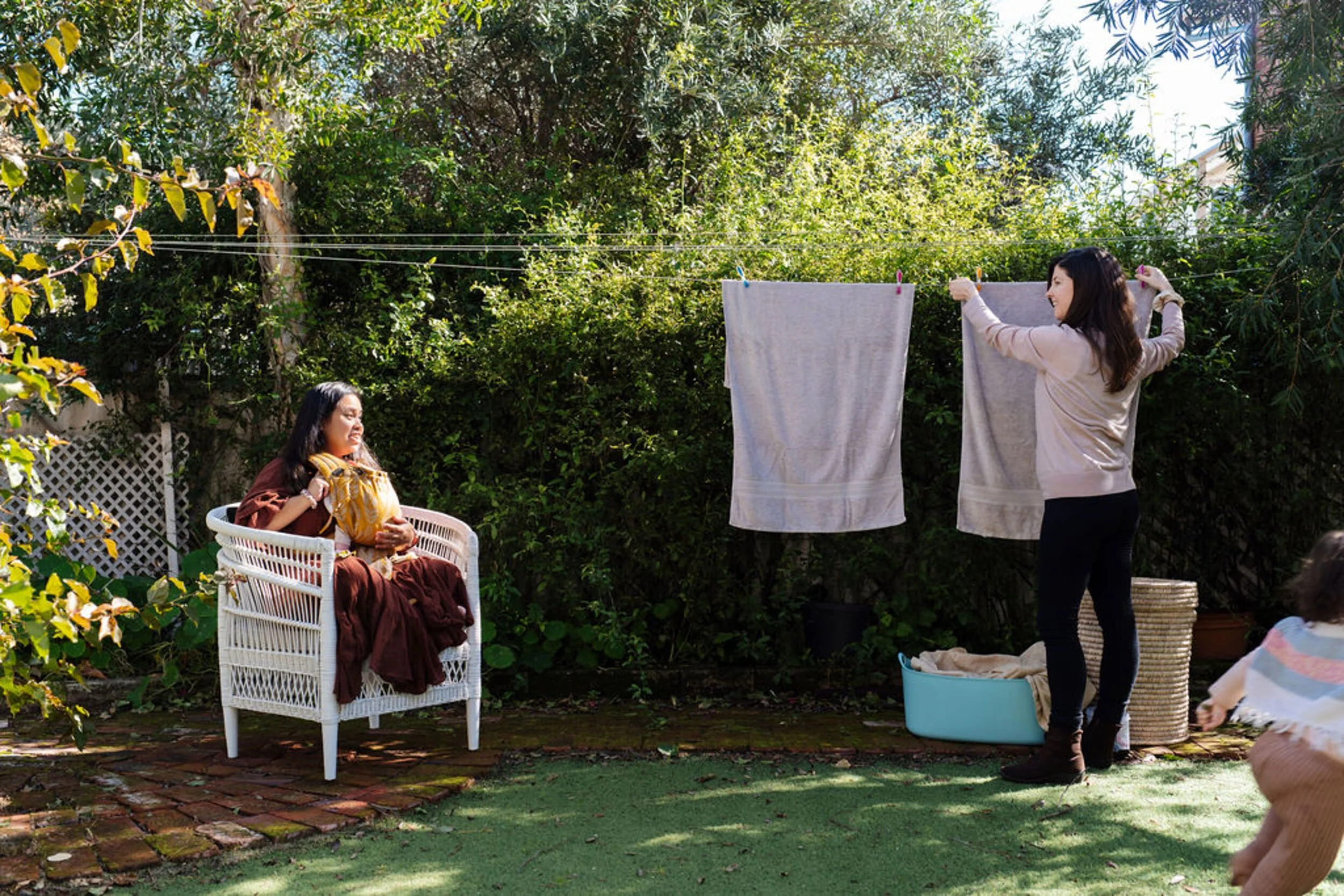
On that note, it turns out money can buy happiness after all; you just need to use it to buy yourself some time. A 2017 study suggests that using money to buy time, such as delegating household chores like cleaning and cooking, is linked to greater life satisfaction.
It can be helpful to reassure new mothers that it’s totally ok to buy a village if they can. If only we could tell all new mums:
I know you could do it yourself (if only there were more hours in the day!) I know it’s hard to let go of control and privacy. I know you might feel guilty or lazy if you don’t do all the laundry, mop the floor, and clean the toilet all by yourself. Society has tried to condition you into thinking your value as a woman is linked to your domestic productivity.
That’s a lot to work through, so it’s no wonder that hardly anyone spends their money on time, even when they can afford it! According to the study we linked above, only half of millionaires choose to buy time. It seems to be socially acceptable to pay for things you do want, but not to pay your way out of things you don’t want.
We’ve worked with lots of new mums. A few of the things they’ve told us they never regretted spending money on include:
A housekeeper to do the dishes and fold the laundry
Meal delivery service—either ready-made or ready-to-cook
A cleaner (aka marriage saver)
Nanny or babysitter
Here’s a wonderful insight on this topic from another of our graduates:
“People kind of worry a bit about spending that on themselves. They think it’s luxurious, which I completely understand. But I try and challenge them and say, would you consider putting aside budget for support first and then look at how much you’re spending on prams and baby clothes and play gyms? Because that stuff is not going to leave you feeling supported in your postpartum. And you can always get secondhand or buy mid-range, not top-of-the-range products. And then allow yourself the extra budget to have practical support. When you look back on this time with your baby, the space to connect with them and the space to recalibrate yourself is what you’re going to remember”
Something to try:
Obviously, your clients made the decision to hire you, so they already know that it’s worth spending money on support. That’s a great starting place. While you certainly don’t want to pry into their financial situations, it might be helpful to ask how it would feel to have a few extra hours in their day.
You could also ask open-ended questions like, “What household task is currently draining a lot of your time and energy? What do you wish you could do, but feel you don’t have the time for? If you had 1-2 extra hours in a week, what would you do with that time?”
The earlier a mother starts building her village, the better…but it’s never too late!
Hopefully, you’ve found a few ideas to help you support newborn mothers. No need to try and do everything; you may like to invite your postpartum client to choose 3-5 of the ideas that bring her peace and joy, and help her implement them.
You can also use a lot of the tips and ideas above to build your own village! Perhaps you’re a mother yourself, or maybe you want to put more support in place so you can grow your business. In the Postpartum Education and Care Professional training, many of our students say how helpful it is to feel supported while they support mothers.
“I’m not sure if I can choose just one favourite thing from this training! I love the sense of community. I wasn’t sure how that was going to be with the training being online but it works so well! I’m not at all technologically advanced so the way everything is set up in Simplero is fantastic! I truly feel like I belong in this group and that my ideas are worth listening to”
“I feel like I am finally on the right path to doing what I love. It’s been the ‘missing piece’ - and one that has given me so much more than knowledge; it’s connected me with an amazing community of like-minded, purpose-driven women who inspire me daily.”
What is one small thing you could do today to help a postpartum parent grow their village of support?
